Jev. Decisions inside software.
From routing an email to choosing a game character’s next move. What changes when a model is built for decisions?
In this essay
What Jev does
An email needs a destination. A game guard hearing a noise needs a next move. Software at these points is waiting for an actionable result rather than a fluent explanation.
Jev is TypeSafe’s decision model. An application supplies state and predefined questions, then receives structured judgments within a defined answer space.
Choice selects a candidate, Score evaluates against ordered levels, and Noul gives a proposition’s probability. Jev does not write new prose or code. A complaint classification still leaves its reply to a person or a generative model.
TypeSafe calls this family System One, borrowing a fast-thinking analogy. In an application, the concrete position is between receiving evidence and taking an action.
“I ordered the wrong item. How can I send it back?”
Which team should receive this?
Sales, support and manual review are supplied candidates.
An editorial illustration of output types. No connection to Jev.
The awkward step in ordinary software
A keyword rule can recognize “refund” and still miss “I bought the wrong thing; can I send it back?” Exceptions accumulate as soon as phrasing and context matter.
Generative models already perform these tasks, including with structured outputs. Jev proposes specializing the model around the decision itself. The question is whether a bounded choice needs the machinery used to produce open-ended text.
Latency shapes where a feature fits. A slow judgment belongs after submission; a sufficiently fast one may participate during interaction. Network and application delays still determine whether that is practical.
Lower costs could make more records or additional checks worth evaluating. These remain testable product hypotheses. Their value depends on useful features becoming feasible, not merely a launch-page multiplier.
From one prompt to inspectable steps
One agent prompt may interpret a task, choose a tool and write arguments. A failure can be hard to locate. An explicit action menu makes one choice separately recordable.
Applications prepare candidates, Jev judges, and code executes. Menus can change with a browser page or a game state. The application still defines what is currently allowed.
Independent questions can share one request. A ticket’s language and department can use the same evidence; a return-deadline check requiring a retrieved order must wait. Batching cannot supply missing data.
Testing also becomes narrower. A classification can be inspected against its candidates; execution failures belong to code or external systems. More explicit interfaces create more specific places to investigate.
“Can you check where my package is?”Which workflow should handle this?
A candidate directly matches the request. Code still retrieves shipment information.
Leaving room for uncertainty
A bare department label is easily treated as fact. Probabilities let an application send some results forward while retaining a review path for others.
Choice and Score return distributions and derived confidence. Concentration does not prove correctness. Noul returns a proposition’s probability without the same confidence field.
TypeSafe targets calibration through RLCD. Checking it requires labeled predictions and observed frequencies; a precise-looking number is insufficient. New application data may behave differently.
A ranking error and an order cancellation carry different consequences. Adjust the eight hypothetical records below to see automation and review workloads change together.
How many decisions go through?
Of 8 hypothetical records, 5 are automated, including 1 errors.
Browsers, guards and an interface
Browser Use’s Jev Ultrafast supplies indexed page elements. Jev selects an operation and target; another model supplies free text when needed. Browser code performs the actual interaction. Public traces expose the handoffs.
Heist/One uses Jev for guard judgments in a browser stealth game while deterministic code runs the world. It remains an observable experiment, not evidence of reliability across complex games.
The experimental json-render integration selects and arranges supplied component instances. Applications provide props and data. A missing chart type or label cannot be invented by selection; rendering and action execution remain separate.
Jev Search applies judgments to source selection, query understanding and relevance ranking while a search service retrieves pages. Switch between the projects below to inspect their respective divisions of work.
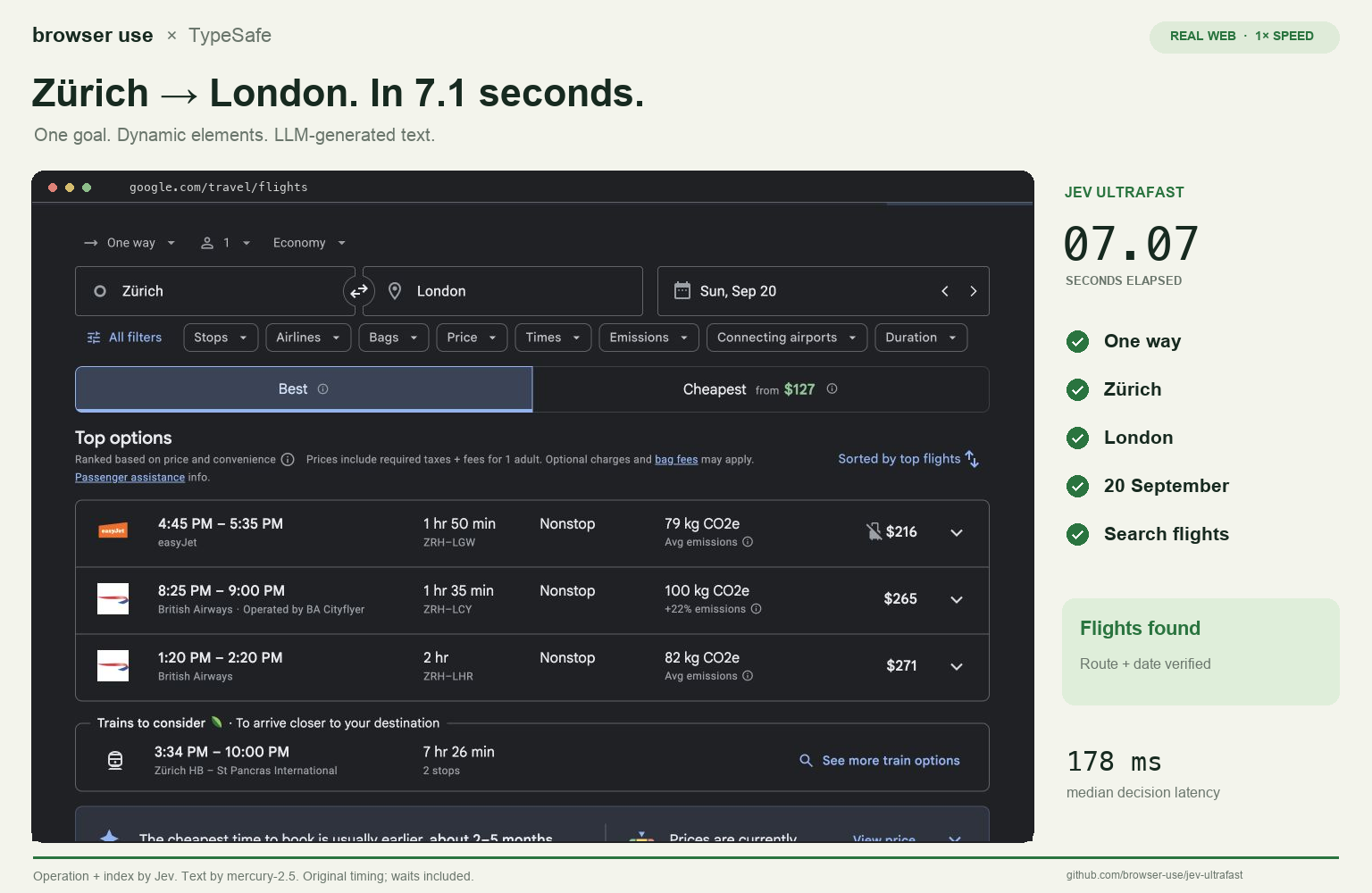
Selects the next browser operation and target element; a separate model writes free text.
The browser extracts the page, validates targets and acts.
Original project media. Switching documentation does not run a project.
What smaller decisions could make possible
Imagine a ticket tool reconsidering ownership when an attachment arrives or an order changes. Its benefit would be shorter waits or fewer transfers rather than a longer response.
A bounded component vocabulary could let an interface adapt to a task without a separately designed page for every state. The design system would still define the available variation.
Generative and decision models might alternate: proposing candidates, evaluating specific questions, and leaving execution to code. Additional calls might also slow the workflow. Finer decomposition is a hypothesis to measure, not a guarantee.
These are possible directions rather than established outcomes. A useful experiment changes task completion. Displaying one more probability without improving the user’s work accomplishes little.
Speed and correctness need separate evidence
Launch speed and cost figures come from TypeSafe’s evaluation setup. Workflow choice, reference answers and structured wrappers affect the result; the vendor describes such caveats.
Jev 1.13 documents weaknesses involving arithmetic, dates and distracting context. Known dates should be compared in code; extracted components can still be validated deterministically.
A structurally valid response can select the wrong button or assign the wrong priority. Type validity and business correctness are separate checks.
Count time until the task finishes, including retries and human corrections. Complete records reveal what a faster decision actually saved.
Start with one real piece of work
Use historical tickets before live dispatch. Define teams and a review exit, then compare existing rules, current tools and Jev on the same inputs.
Keep some records out of prompt and candidate tuning. Inspect uncommon costly errors separately so that averages do not hide them.
Connect execution only after decision quality and latency are acceptable. Keep permissions and outcome checks in code, and sample later results for changes in incoming data.
A model call ends quickly; its candidate menu keeps evolving with language and business needs. When a new department opens, that original candidate menu needs another edit.
Sources.
01Browser Use / Jev Ultrafast02TypeSafe / Introduction03TypeSafe / Introducing System One Models & Jev04TypeSafe / Choice05TypeSafe / Score & Noul06TypeSafe / State07TypeSafe / Confidence08TypeSafe / AI primer09TypeSafe / Confidence-gated routing10json-render / Jev (Experimental)11TypeSafe / Jev 1.13 jaggedness12AbdelStark / Heist/One13superagents-lab / Jev SearchKeep reading.
Official documentation, Chinese guides and developer experiments.